Friday, 6 July 2012

Climbing - Part 3 - Technique - Back to basics

This third article on climbing looks at how you can improve climbing technique to make climbing easier and faster.

The main technical areas where most riders can improve are; pedalling, breathing, body positioning and timing and controlling their efforts. Trying to improve in several areas at once is difficult so for most people spending a bit of time on each until it becomes habitual and then moving on to the next will provide the best results.

Modern bikes offer different gearing options compared to those used for racing 20 or 30 years ago so some techniques have altered to take advantage of that. Previously very low gears were used by tourists but those gears were too widely spaced to be practical when racing so often when racing riders would push higher (heavier) gears than used today. The changes in gearing include more sprockets on rear wheels enabling a wider range of gears, whilst still keeping close steps between the ratios, and compact and triple chainsets enabling smaller rings to be used at the front.  Because of this riders would be well advised to look at the techniques of top climbers from the modern era rather than those from the past.

Technique 1 - Pedaling

My previous post "Pedalling - back to basics" covers various aspects of pedalling and much the same priciples apply when riding up hills although when climbing the cadence (how quickly the pedals are turned) would normally drop compared to when riding on the flat.

Many riders pedal too slowly up hills and rely on brute strength to keep moving perhaps moving body weight around to add some extra force to the pedals. Watching top riders climb you can see that most of them are actually still turning the pedals quite quickly and it is when a rider 'blows' that the cadence really drops.

How fast you should pedal would vary depending on the physical shape and natural rhythm of each rider but for a rider who rides at 90 to 100 rpm (revs per minute) on the flat would climb most hills with a cadence of 70 to 80 rpm.

For most riders that kind of pedalling rate seems very high and the only way to make it feel natural is to train at high cadence on hills, at first it will feel un-natural and you'll get breathless (see below for technique) more quickly but with perseverance it is effective.

The Science Bit

In simple terms when climbing at lower cadence the leg muscles will fatigue more quickly because of the higher force they have to apply to the pedals. At the same speed with a higher cadence the force exerted each time a pedal is pushed is lower BUT pedalling at a higher cadence will burn up more energy causing the heart and longs to work harder. There is a choice between putting more stress on your leg muscles or burning more energy. As long as energy supply and hydration are sorted the second is usually more effective.

There are couple of good articles on this subject see;

http://www.bikeradar.com/fitness/article/technique-pedal-like-a-pro-12772/

http://bikecan.nationalmssociety.org/site/PageServer?pagename=BIKE_CAN_CyclingResources

Technique 2 - Breathing

It seems almost too obvious to say, but it often needs to be said; However fit and strong you are if you don't breathe you won't move. If you don't breathe effectively then you won't climb effectively.

Ideally most breathing at areobic levels is done via the diaphragm and you should breathe in a controlled and calm manner - once you are gasping or taking short fast gulps of air then you are getting insufficient oxygen for the effort you are making, the work becomes anaerobic and you will fatigue quickly, power will drop and you will build up lactic acid which will hurt your muscles.

Technique 3 - Body Position

When climbing wind speeds are relatively low so win resistance is less important than it is on the flat. This allows you to ride in a more upright position and that in turn helps with effective breathing.
Keeping your head up will also ensure the air pathway to the lungs stays clear.

Sitting on the saddle when climbing uses fewer muscles than standing up so when climbing for a long time sitting down requires less oxygen. Sitting down and gripping the top of the bars (on dropped bars) reduces pressure on the diaphragm and keeps the airways open making breathing easier. The easier it is to breathe the more energy you can generate to climb. Often holding the bars toward the middle means that your elbows are further out from the body and this gives more room for the intercostal muscles (between the ribs) to move so that you can beathe more deeply.

Like the pedalling techniques above this does not always feel natural at first and repeated training using these techniques is required to make it feel more natural and to be able to climb like this for longer.

Sometime when you want to accelerate,  the gradient is too steep or your gear not low enough (or you can't manage to maintain the seated position any longer) you will stand on the pedals - this allows you to apply more force to the pedals but the effort will tire leg muscles more quickly.

When climbing standing on the pedals (out of the saddle) you need to concentrate on breathing and balance. Breathing - keep your head up, keep elbows comfortably apart. Balance - keep enough weight on the back wheel to maintain good grip and prevent the wheel from slipping but keeping enough on the front wheel to keep it firmly on the road.

When moving from a sitting to standing position the bike will tend to slow down briefly while you make the transition and in close groups could cause a crash. To prevent that you should push harder on the pedals to lift yourself off the saddle rather than just standing up in a natural way.

Technique 4 - Timing and control of effort

Some riders climb best on short hills of a couple of minutes or less while others prefer long climbs taking to minutes or more. Whichever you prefer you are always going to have to climb the other sort of hills and you should measure your efforts so that you are riding strongly as you crest the summit. Knowing how hard to ride to crest the hill strongly comes with experience and getting to know where your own thresholds lie - both of those things come only with training - lots of training.


In summary - How to become a good climber

The old way to become a good climber was to get on your bike and climb hills, and do it again and again and again. That is still the best way but with attention to techniques and power to weight it will be even more effective.


Sunday, 10 June 2012

Climbing - Part 2 - Power to Weight - Back to basics

In part 1 I concluded with the two things that make climbing harder than it could be for most cyclists and the reasons are insufficient power-to-weight ratio and technique, and that both can be improved through training. This post looks at the first of these; training to tackle the power-to-weight ratio.

Clearly there are two issues to tackle here and in order to be most successful there is a need to strike a balance between them. Power can be increased by using specific training but doing so can increase body weight. Various training and dietary techniques can reduce weight but can also reduce power.

So how can you improve your power-to-weight ratio without gaining weight or loosing power?

Unless you are already very fit and trained in cycling the first step is to ride regularly and at a pace that makes you breathe hard and for half an hour or more at a time. Doing this consistently over a couple of months will bring basic "bike fitness" (i.e. being able to cycle for an hour or two fairly easily and able to start some more challenging training).

Assuming you are already bike fit then let's look at power-to-weight specific training. Joining a gym and following a planned programme of resistance training can be effective but as the training can be done on a bike why pay to use the gym.

POWER

The basic principle of training (see my previous post "Back to Basics - What is training?") means that repeatedly stressing the body by carrying out a particular activity will cause it to adapt and become more effective at that particular activity. The more a rider climbs the better they will become, but if the climbing is done at slow speed that's where the improvement will come.

To boost the power for climbing will involve work hard on the kinds of climbs where improvement is desired.

Short Steep Climbs

To boost your power on steep climbs find a steep climb which takes at least a couple of minutes to climb, the sort of hill generally climbed standing on the pedals. For those without access to the necessary hills a turbo trainer with fairly high resistance can be used instead. 

Initially you should warm up thoroughly and then start to train on the climb making repeated short efforts with recovery periods between (interval training). You should make efforts of 40 to 60 seconds duration, pushing a fairly hard gear and accelerating as much as you can in the last few seconds of each effort.  You should be trying hard enough that by the end of each effort it is difficult to keep climbing.

In the first stages of training you might be able to manage four efforts with a gap of a few minutes between (e.g. 50 second efforts with 3 minute rests). The rest periods are important and you should pedal easily during them but don't stop pedaling. As you improve you could increase to 6 or 7 efforts in a session. After that you shouldn't need to increase the number of efforts but you can always increase the effort you make each time by riding faster and pushing a higher gear. If you can manage more than 6 or 7 efforts then you are not trying hard enough in each effort. The rest periods should stay the same so that each time you make an effort you have had the proper recovery period.

After your interval training you need to ride some more at a steady pace to let your body warm down properly.

Long Drags

Long drags are climbs which are usually tackled sitting on the saddle and take at least a few minutes to climb.

Interval training can boost the power needed on these climbs but the efforts will each be significantly longer and normally done sitting down. Like for steep hills you should be pushing hard and try to increase your pace at the end of each effort. When starting this type of training you should aim for about four efforts each of 4 to 5 minutes with rest periods of the same length.

Over time the length of the efforts can be increased rest periods should not be lengthened and may even be reduced (e.g. climbing for 15 minutes and only resting for a few minutes whilst cycling back down the hill before climbing again). About 30 minutes total climbing in a session should be plenty even for the fittest climber, remember you can always ride faster if it isn't hard enough.

Technical Climbs

The climbs I define as Technical are those where the gradient changes during the climb and there are often twists and turns which tend to interrupt the climber's rhythm.

The single climb is likely to go on for some distance but the changes in gradient and rhythm mean that it is a mixture of the long drag and the steep climb, sometimes sitting down and sometimes standing on the pedals. Effective training for the two types of hills, as above, will generally enable you to handle this type of climb quite effectively. If necessary you can train on this type of hill or undertake sessions combining interval type efforts on both types of hill. Making extra effort at the points where the gradient and direction occur will boost your ability to handle such changes in future riding.

WEIGHT

To have a high power-to-weight ratio the rider should aim not to carry excess body weight.

In general training on the bike is good for controlling body weight. Training as described above for climbing steep hills may cause a minor increase in body weight but the weight will be more than offset by the increase in power. Training with weights in a gym can cause significant increases in power but these can be accompanied by increases in body weight which are too great to be offset by the additional power when climbing.

If the rider needs to reduce body weight significantly to help with climbing then simply increasing exercise whilst not increasing calorie intake is the only reliable system. To lose the weight too quickly can risk causing a loss of power and lack of energy making recovery more difficult. It is therefore important to continue to eat healthily whilst increasing training.

Significant weight loss should be always be gradual and at a rate which doesn't create an ongoing feeling of fatigue.

TECHNIQUE

In my next post on climbing I'll look at how technique can be improved to climb more effectively.


Monday, 4 June 2012

Great Manchester Cycle - back to basics paying off!

The Great Manchester Cycle took place today and I lined up in Sport City at about 7.30am with 1500 others ready to tackle the 52 mile ride. A little early drizzle had cleared and occasionally the sun shone, but it was quite windy and still only 9C. My training over the recent weeks had consisted mainly of commuting, a 27 mile round trip 3 or 4 days a week on my Brompton. In a back to basics style that training was simple, riding more than normal and sometimes riding harder (especially on the way home).

After a long wait near the start line I took off my rain jacket with 30 seconds to go, stuffed it in my jersey pocket, and was ready to go. The start itself was fairly steady and it took a while, with so many riders of differing abilities and experience, for groups to form and settle into a pace.

I had planned a steady start and hopefully a nice steady group at 20mph or so. Turning towards the Mancunian Way with a fairly strong following wind the noise of tyres and the buzz of riding fairly quickly in a bunch were too tempting and I found myself clipping along between 25 and 28mph. Through Salford Keys the route got narrow and had 'interesting' features including bollards and posts in the middle of the narrowing paths. This first time through everyone slowed down and we came through unscathed with a group of about 10 as we headed past Manchester United's stadium and towards the city centre.

Heading back to Sport City the wind was in our faces and the group constantly changed as we caught up with riders who had started a bit more quickly and dropped others. Back in to Sport City and the course became a little more technical with a few nice tight turns. Riding my old road bike in such circumstances brought back memories and the bike itself handles such corners, and sprinting out of them, as well as it used to.

Perhaps I was a bit over-enthusiastic but I was having fun and kept moving up, group to group, and stayed with riders younger and fitter than I am.

There's usually a price to pay for such behaviour and for me it came in the shape of cramp sprinting out of the corners at Old Trafford on the fourth and last lap. First a twinge in my quads and soon afterwards in my hamstrings at which point with 5 miles to go it was time to back off a little and stretch the muscles. I watched the group disappear up the road all the time shedding riders in ones and twos as the headwind took its toll.

Not wanting to stop I did some stretching and 'heel of the hand' pressure on the affected muscles whilst pedaling more gently in a slightly lower gear and the cramps eased. With 3 miles to go I was able to build up the pressure gradually and got back to a reasonable pace into the wind for the finish. Around the final bend at Sport City and the commentator announced my arrival "number 773, Seamus Kelly, must be from Ireland"

For me it was a good morning finishing 186th out of about 1500 riders and well ahead of my planned time.

For thousands of others it was a good day too, the keen sporting cyclists, the triathletes, the families and those riding for a cause. It was amazing to see thousands of cyclists enjoying the day and their own personal achievements. Around the finish are you'd have struggles to find anyone without a smile.

Here's hoping this will run again next year.

Thursday, 24 May 2012

Sharing the Roads - Safety Quiz

The following quiz is for cyclists and drivers alike. The "A" responses are split for cyclists and drivers simply pick the appropriate answer, if like most cyclists you are also a driver you could.

As you go through make a note of your selected multiple choice answers and check them at the end and see what sort of road user you are.


Questions

1) The traffic light ahead is about to turn red, what do you do?

A (drivers)  - Press the throttle to accelerate so as not to get caught out by the light
A (cyclists) - Keep pedaling bikes don't really need to stop
B - Ease up and stop if the light is red - there will be a green along in a minute
C - How do I know if it might turn red?

2) What do you do at advanced stop lines when the lights are red?

A (drivers) - Drive into the box as long as there's no bikes in it
A (cyclists) - Move ahead of the traffic and put my bike ahead of the box
B - Stop behind the box in my car or in the box on my bike
C - What are advanced stop lines?

3) How much room should you allow when passing a cyclist?

A) (drivers) - Enough so my car won't get messed up
A) (cyclists) - A foot or so, I'll be past quickly so they'll hardly know I'm there
B) - The same as passing another vehicle and at least a metre
C) - Cyclist! what cyclist?

4) If a cyclist is riding well out into the road approaching a junction what do you do?

A) (drivers) - rev the engine, beep and pass as fast an close as possible to teach them a lesson
A) (cyclists) - pass on the inside, make a comment or offensive gesture to teach them a lesson
B) - Wait patiently behind as he's probably making sure he is safe until past the junction
C) - Junction! what junction!

5) A long queue of cars has formed and you want to turn right about 5 cars along. What do you do?

A) - Pass those 5 cars on the wrong side of the road indicating to make it alright
B) - Wait until you can make the turn correctly from your own side of the road
C) - How many cars did you say?


How did you do?

Mostly "A"s - You are a facist driver/cyclist! You shouldn't be allowed to share our roads and your vehicle should be melted down to make speed cameras.

Mostly "B"s - You are patient and respect other road users. I'm happy to share the roads with you, even if you are a little too good for your own good!

Mostly "C"s - You really aren't trying are you. I'm not sure you should be on the roads at all, even when you've sobered-up.


What if your Brompton punctures?

Changing inner-tubes on the small wheels of the Brompton is always a bit of a pain. Using Marathons and Marathon Plus tyres seems to have greatly reduced the number of punctures but what if it happens. Out come the extra strong tyre levers and all that swearing and faffing trying to get the tyre back on.

Well today I have the solution.

The Clown bike is a little bit heavy for the front of the pack, perhaps it would fit better on a rear rack, but it is very strong, has a very low gear for climbing (it has a very low everything really) and it has solid tyres so you'll not get another puncture while you cycle on with the Brompton on your back.


Tuesday, 15 May 2012

Climbing - Part 1 - back to basics

Riding bikes up hills is the thing most cyclists find difficult and it is especially difficult for novices. Most people end up learning to climb without much help or advice and often end up finding it much harder than they ought to.

To understand why riding up hills is hard here's a little bit of science (skip the green bit if you don't like science):

The Science Bit

When Albert Einstein worked out one of the best known pieces of science he probably did it because he realised how important it is for cyclists wanting to ride faster or climb hills.

e = mc(2)

In words the formula reads "energy equals mass x constant squared"

The formula is used to show how much energy is required to move an object. But what does it really mean?

"Energy" most of us understand, although it comes in a variety of forms, and when riding a bike the energy is provided by the engine (the rider) except when heading downhill when something called potential energy comes into play.

"Mass" is a bit like weight in that it is a measure of the amount of material in something (the weight of an object varies depending on its location but mass is always the same - think of how light things are on the moon)

The "Constant" is a way of measuring the things that affect the movement of the object like gravity, friction etc.

When riding a bike on a level surface the constant is mainly made up mainly of air resistance (the coefficient of drag, the CD value car makers used to publish in the 80s, multiplied by the speed of the bike) and the mechanical efficiency of the bike and the drag from the road surface (these last two are relatively minor). The squared bit at the end of the formula means that to double the speed of the bike requires four times the energy.

Riding up a hill the constant includes a measure of the gravitational pull of the earth (itself a constant  called g) as well as the factors applying on the flat. As speed is much lower going up hills the air resistance becomes less significant and the energy requirement to ride against the gravitational pull of the earth becomes the most significant factor.
__________________________

What does it mean in simple non scientific terms?

So does that mean that the lighter you are the better you can climb? Not necessarily classic climbers like Lucien Van Impe, Robert Millar or Marco Pantani were all very slightly built but what about Eddy Merckx, Bernard Hinault and Big Mig Indurain who all climbed brilliantly and were much heavier riders (with much more mass). The bigger climbers simply needed more energy to climb at the same speed as the lighter ones and in the examples given they had sufficiently powerful engines to be able to produce that amount of energy.

The important factor to be able to climb really fast is to have lots of power compared to how much you weigh (a high power to weight ratio).

There are two main reasons why climbing is harder than it should be for many riders and these are:

a) power to weight ratio is too low
b) technique needs improving

In the following two posts Climbing - Part 2 and Part 3 - I'll take a look at how to use training to tackle the power to weight issue and how to improve technique to climb more effectively.


Friday, 4 May 2012

Pedalling - back to basics

One constant in cycling is the need to pedal effectively. The more we pedal the more the body will adapt to pedalling and the better it becomes.

Technical

Pedalling looks pretty simple and it comes naturally when you ride a bike a lot. There is just one really important technical issue with pedalling which relates to the correct position of the foot on the pedal. When pushing on the pedal the ball of the foot should be directly above the axle.

Think about running and jumping, the power is always delivered through the ball of the feet, the same applies to riding a bike, maximum power is applied through the ball of the foot. This gives rise to lots of discussion about the types of pedal and cleats. In reality most pedals with cleats (sometimes called clipless pedals) work perfectly well for those that want to use them although each rider will tend to have a preferred system.

For maximum power delivery the soles of the shoes used should be pretty rigid. There is also a theory that flat pedals work perfectly well and for most purposes except racing that is probably true, I've used flat and clipless systems for commuting and MTB and most of the time they are fine but in a sprint or hopping over an obstacle on a road bike the clipless have an advantage.

There are lots of studies and articles about pedalling technique but none that conclusively prove that techniques such as “ankling”, trying to pull on the upstroke or dragging the pedal through top-dead-centre make any measurable difference to the overall effectiveness of the rider. Training to pedal is therefore achieved by simply pedalling, lots and lots of pedalling.

The muscles that do most of the pedalling actions will develop as more of the fibres come into use and the circulation in the legs will improve in order to supply oxygen to the muscles. The muscles that are used  the most get bigger as more fibres are brought into use. That’s why after years of riding cyclists legs get to look different from other people’s legs (that and the shaving!).

How quickly should you pedal?

Does matter is how quickly you pedal. Ideally you should probably pedal faster in training than you think you should. If you want to know what quick pedalling looks like watch any video of Lance Armstrong - whatever he did or didn’t do in terms of doping he certainly developed the ability to pedal  quickly and comfortably.

Most people don’t pedal quickly enough and then in a competitive situation when they need to pedal really fast they can’t. If you train by pedalling slowly then your body adapts to be able to do that and pedalling fast is going to be difficult. If on the other hand you pedal more quickly when training the body adapts to be able to pedal quickly but it can pedal more slowly without difficulty.

Summary

Pedal quickly when training (watch Lance!)
Pedal with the ball of the foot over he axle
Pedal lots and lots

My next "Back to Basics" topic will be climbing with a bit of science for good measure.


Tuesday, 1 May 2012

Back to Basics - What is Training?

In cycling there are three main types of training which can be defined as:

physiological - adaptation of the physical attributes of the body
technical - development of physical skills and techniques
psychological - development of mental skill and techniques

The Training Effect

The human body is a very clever design and in essence if it needs to do a particular action frequently then it can adapt itself to become better at that action.

In very simple terms if you want to run fast then you keep running as fast as you are able and  over a period of time the body will make changes enabling it to run faster (see the science below). If you keep pushing to what seems to be your limit in this way the body will adapt in a wide range of ways to make that possible. All of those adaptations put together create the “Training effect”.

This is hardly new science and it is how human beings have trained for sport, for war, for work and for survival over many thousands of years.

At the same time human beings have used the basic training methods to develop technical skills, lots of repetition and carefully building up the parts that make a technique to become more effective. That's the way farmers learned to plough the land and also how soldiers learned archery. Those same principles apply now to those of us wanting to become more effective cyclists.

In psychological terms repeating a process enough helps to alter the pathways in the brain and is part of the effect of technical skills training. In addition the brain is able to learn things through effective thinking techniques such as visualisation and can benefit from strategies to boost morale. It isn't really surprising that increased morale actually boosts physical performance.

What do we need to do, and what do we need to understand, in order to become better cyclists?

The answer to that question depends on a wide range of variables including the specific areas of cycling where we want to improve. Do you want to ride further, faster, climb better, sprint better etc. These specifics will be addressed in the following blog postings starting with the one constant in cycling; pedalling


The Science Bit

There is an excellent explanation of the theory of adaptation in physical training from Colorado Sports Training at;

http://coloradosportstraining.com/site/physical-load/adaptation-as-a-main-law-of-training

In simple terms all organisms have the ability to respond to stress by adapting.

If your circumstances mean you have to run away (e.g. from large carnivores) frequently then your body increases the capacity of the heart to pump enough blood, increases the capacity of the lungs to supply oxygen to be carried in the blood and increases the number of fibres brought into use in the leg muscles. Of course if you have to run away too many times without giving your body time to rest and to make those adaptations while resting then you are likely to get caught (and eaten). This is where evolution kicks in because the better adapted are more likely to survive and breed etc.

By carefully planning your training you persuade your body, by creating the right amount of stress, that it needs to adapt and then you give it the necessary time and nutrients to make the adaptations and you become more effective.

Sunday, 22 April 2012

BWC2012 Launch - Manchester

Bromptons in the Velodrome
Today Manchester was busy with Brompton's for the official launch event for the 2012 Brompton World Championships. It was a bit like a teddy bear's picnic "If you go down the canal today, you're sure of a big surprise ..." and 60 Bromptons on the towpaths in the rain certainly caused one or two surprises.


Gareth Rees (winner of the London Nocturne Folding Bike race)
 The action started at the Rainy City Velodrome, home of British Cycling, with people arriving from all over the place. There was Ian from Northampton, Mick from Aldershot, Alan and Jill from Leicester and a bike shop owner from Sunderland. There was world champion Rachel Elliot, Gareth Rees Winner of the London Nocturne and a whole team of people from Brompton in London. There were black bromptons, pink, yellow, claret, white, blue, red-white-and-blue,  and Bromptons of a thousand colours. There were enough to fill a Christy Moore song.

Tagging along with the factory team
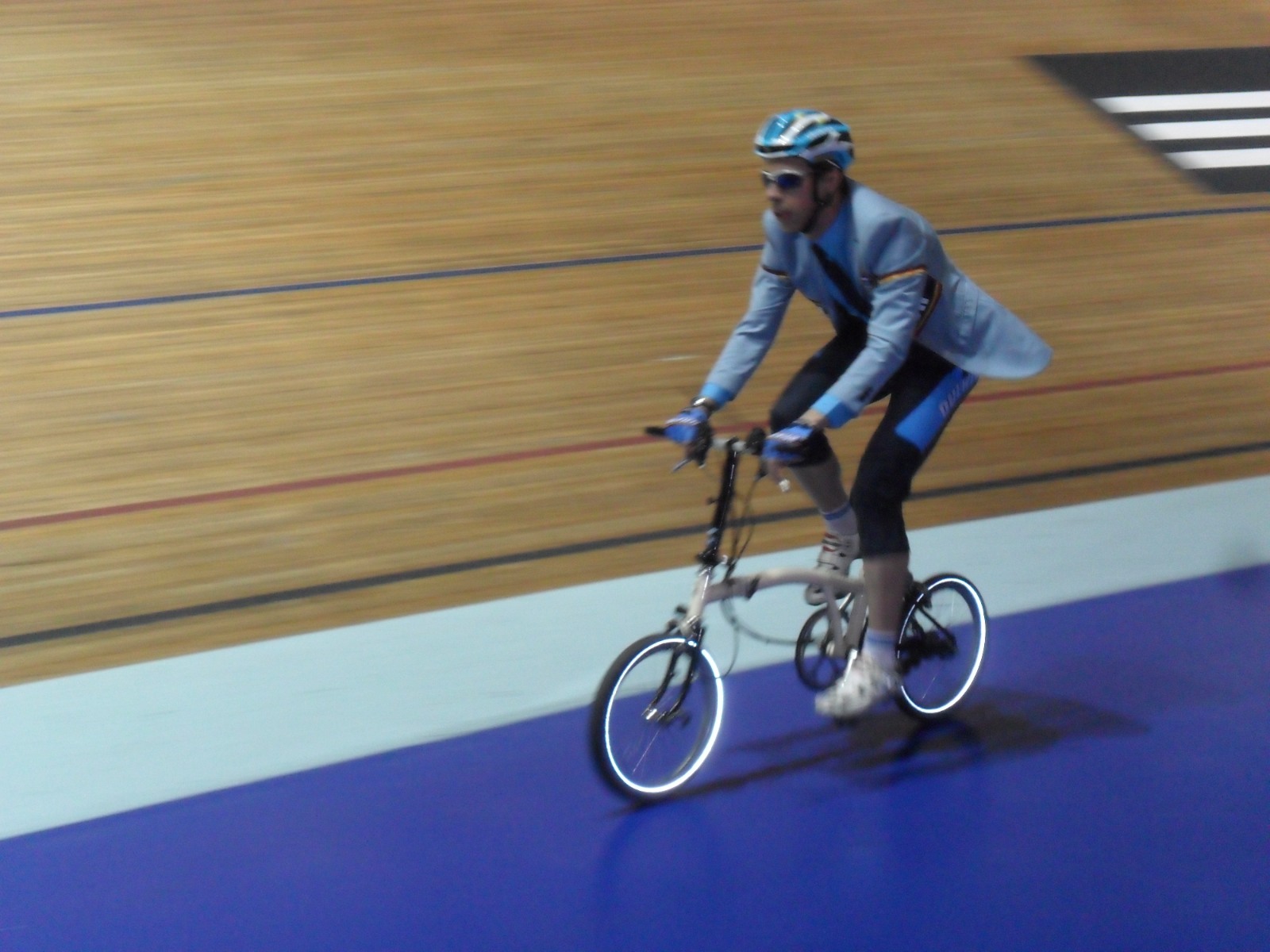
Down at the trackside the Bromptons circled round and round the blue area and the riders fought the temptation to ride up on to the wooden boards (if anyone saw me it was an accident, honestly!). After plenty of laps of the dry velodrome breakfast was provided in the Velopark cafe before a couple of photocalls and a briefing and off we all went to scare the geese on the canal.

The rain grew heavier and the cobbles got more slippery but determined riders refused to put feet on the floor. Around the Fallowfield Loop, through Chorlton and back to the city centre where the London style marshalling came as a shock to the northern motorists (but at least it woke them up and they were more observant).

The atmosphere from start to finish was friendly and relaxed and the Brompton Team should be congratulated on an excellent job

Bromptons on turbo trainers
At the end of the ride everyone was smiling and chatting and enjoying the excellent company

Shortly afterwards I was back on the bike to pedal home and complete my longest day on the Brompton (just over 46 miles).


Wednesday, 18 April 2012

It's not always sunny, but it's always good for you!

Today and I had a meeting with a colleague in Hebden Bridge. The weather was pretty wet and quite cold but of course we both arrived by bike. The canal paths got wetter as the day went on and the overflows were very slippery. The rain became incessant and hands got quite cold with very wet gloves on.

In the end though a 30 mile ride, when you really wouldn't want to go outside the front door, is still pretty good. You still get exercise and once you've got going you can still enjoy the fresh air and the outdoors.

Today I saw a Yellow Wagtail beside the canal, I've not seen one for years, and the usual range of ducks, geese and a heron. This cycling stuff isn't only good for your body, it's good for the mind as well.


The Science Bit

Note the science here is mostly correct but sometimes it may be totally made up. It's up to you to decide which each day.

How does riding in rubbish conditions benefit the mind?

The simple scientific answer is: Endorphins

The more detailed scientific answer is: When the body is subjected to certain stresses and also to certain pleasurable things (i.e. stimulae) the production of certain hormone related substances is increased. These substances include endorphins, sometimes called the "feel-good hormones" and sure enough they make you feel better.

The secondary scientific answer is: Whilst cycling in difficult conditions, including very slippery overflows like the one above, your mind is occupied by the immediate physical requirements and the parts of your brain which might be worrying or feeling pressured effectively get a break.


Friday, 13 April 2012

Back to Basics - Scientific Training

When reading about a "Back to Basics" approach to training some people may assume that I don't approve of scientific training methods and principles. But the back to basic training methods are actually rooted in and backed up by science.

The early scientists didn't have the range of tools and equipment that modern scientists have but the principles that they worked out underpin most modern science. Similarly the successful training techniques used by cyclists in the "Pre-Baordman" era actually underpin the work done since by the likes of Peter Keen and Brailsford's team.

So, if modern scientific methods are better, why would anyone choose to use anything other than the newest most scientific methods?

The answer is quite simply that for most of us what we are trying to achieve can be achieved without the need for lots of expensive equipment and coaching. In a way if it was good enough for Eddy Merckx it ought to be good enough for you and me.
  • We want to get a bit fitter
  • We want to loose a bit of weight
  • We need to climb faster
  • We need to sprint faster
  • Our tactics leave room for improvement
  • We want to finish that sportive
  • We want to place in the 4th cat race
All of the above can be achieved using a more basic approach to training and by our own efforts with a bit of guidance and without the need for HRM, GPS, physiological testing, power measurement etc.

For some there is a real need for more; 
  • if you are trying to add a few metres onto a World Hour Record 
  • if you are looking for the edge to win the Tour prologue
  • if you are just a fraction away from winning an important TT
  • if you are loosing sprints by a couple of inches (in a proper race, not the clubrun!)
If you are in those situations then you've probably exhausted the basic techniques just to get there and now you need the little extra edge that the latest scientific techniques can give you.

If not then Back to Basics can save you a fortune and get you where you need to be. So I'll be writing a series of Back to Basics training blogs and for those into the scientific approach I'll include the science behind the basic methods.

Tuesday, 10 April 2012

Wet, windy, why cycle?

Easter finished and like many people I've been decorating. Early starts and late finishes left me somewhat tired and I know I still smell of paint!

Being too busy to cycle for a few days normally leaves me itching to get back on the bike but it's April, it's raining and the wind is strong, cold and in my face. I didn't want to get out of bed yet alone cycle to Manchester!

Breakfast done and water-proofs on I set off for work a little later than usual. Going uphill straight from my front gate is rarely fun. Today my legs didn't want to know and my body ached. I asked myself why I do this.

Three times I passed quite close to train stations and was tempted to take the easy way out. But trains would mean noise, queues and more than likely I wouldn't get a seat. I carried on cycling.

About half way I was feeling better and didn't mind the wind and the rain was keeping me pleasantly cool. I really enjoyed the remaining seven miles and don't feel tired any more.

Cycling is the only way I know to convert knackered, inert mind and body into a happy, fresh and enthusiastic worker. Now it's time for another coffee - decaf of course, who needs caffeine?