Tuesday, 7 June 2016

Sunshine and Poetry – Best way to work


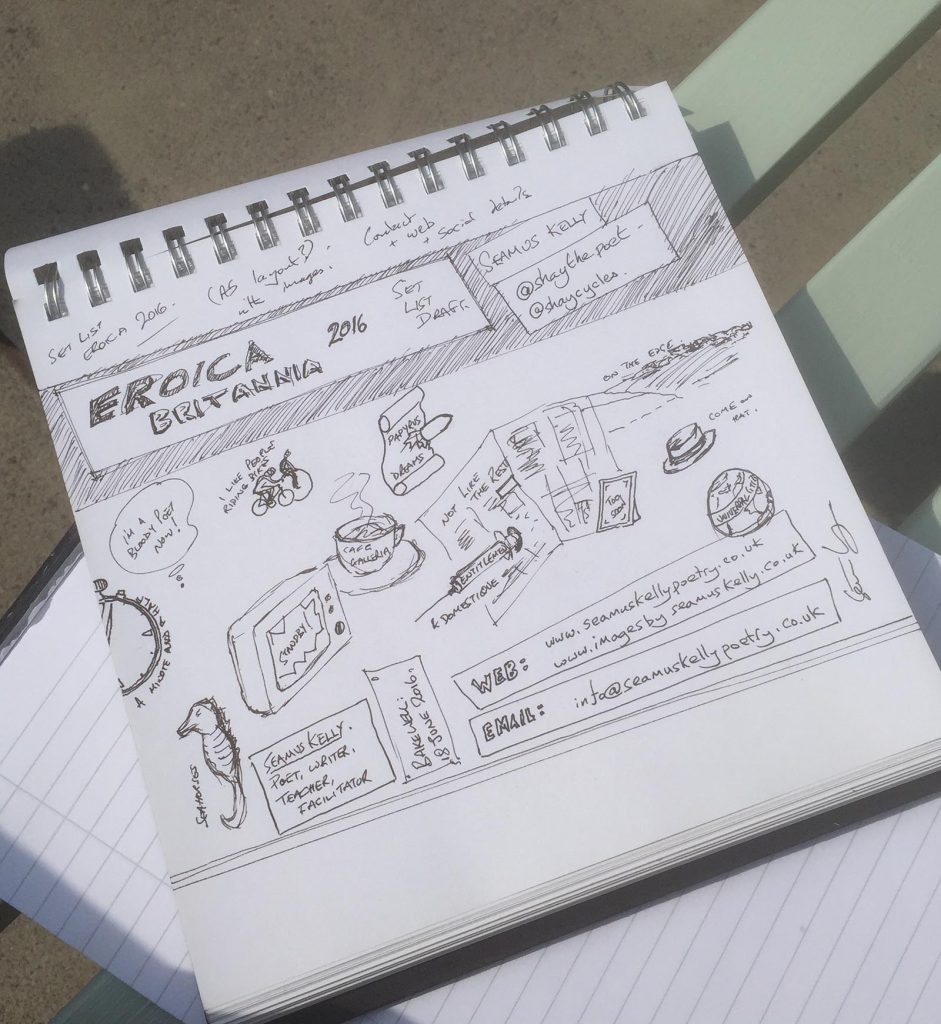
Picture of the set list with doodles
Set list for Eroica 2016

This morning the sun has been shining, the mercury nudged past 24 degrees and the garden bench beckoned. I’ve dealt with emails, checked the social media and then set to work in this rather warm and temporary office.
My set list for Eroica Britannia (now only 11 days away) needed some more thought and, as I tend to doodle while I think, I have ended up with the illustrated set list as shown below:
I’ve yet to decide the order for the set but I know where it will start and I have a pretty good idea where it will finish too and the middle will always find its own way if necessary.
Perhaps I’ll produce some printed copies for the audience once it is finalised – I’d be interested to know if people think this is a good idea; please comment here or let me know on Facebook at – “shaycycles”

Saturday, 4 June 2016

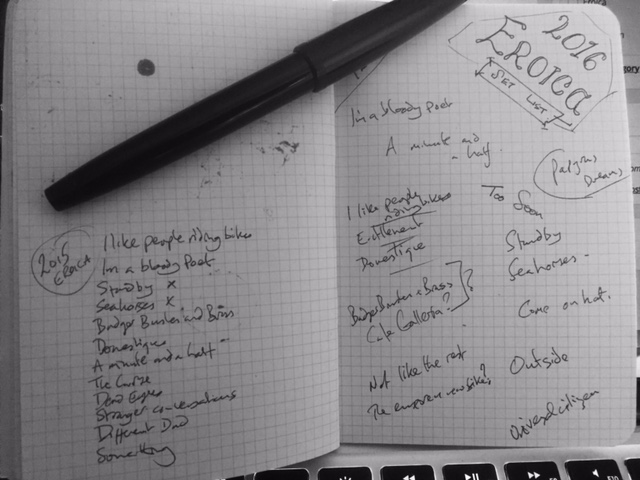
Eroica Britannia 2016 - Set List grows

With just 2 weeks today until Britain's most handsome festival of all things cycling and vintage my set list is taking shape. Like myself it has become a bit larger than it ought to be and over the next couple of weeks it needs to trim down a little.

Picture of my developing set list for Eroica 2016 in notebook
My developing set list for Eroica 2016

There are a poems that have been heard around the country, poems that have only been heard close to home and a few that have never yet been heard in public. The task challenge in finalising a set list is to appeal to the audience, to get over whatever messages are intended, to give the audience a range of emotional experiences and of course to do the things we love to do. For my Eroica set the questions include:

  • How many poems about cycling? (currently 5 or 6 on the long-list)
  • How many political poems? (tricky just days before the referendum, 1 or 2 on the shortlist)
  • How many personal and family poems? (a few that have wide enough appeal)
  • Can I risk the really serious subjects? (can I avoid them - no - so yes there's a few in the long list)
  • Can I risk making the audience cry? (can I even stop them crying)
  • Should I give them something to laugh or smile about? (of course - even if just to stop them crying)
  • How many old ones?
  • How many new ones?
  • How many can I fit into a half hour set with room to breathe, to listen, to digest, to laugh or cry and to chat with the audience?

So here I am in the middle of the night adding and subtracting from the list, a mini-referendum for each poem; in or out?

And as I think I'm nearly there I wonder about finishing one or two of the bunch of poems still under construction, but it gets late and "what if they aren't ready, what if they won't be good enough?" and the poet tries to get some sleep.

Thursday, 2 June 2016

Countdown to Eroica Britannia 2016

Last year the organisers of the UK's greatest festival of all things cycling and vintage gave me a slot to perform my poetry in their Arts tent. The experience was terrific and you can read about it in my posts from last year's event.

nib with ink 7
Pen nib with red ink
I am really delighted to say that I've been invited back for the 2016 Festival and will be performing at noon on Saturday 18th June.

I'm busy planning my set for the event and I'll be sure to include some of my poems about cycling and of course some of my newest poetry. It would be safe to assume that the set will be designed to entertain, to inform and most of all to give pause for thought.

I'll be reading work from my book "Thinking Too Much" and a range of my more recent work including some about my own family which, although very personal to me, are likely to resonate with any listener. There will be copies of my book available for sale and I'll be very happy to sign copies after the performance, I may also have a selection of my vintage cycling images for sale and will be happy to take orders on the day.

Come on Hat poem
Here's one of my recent poems under development- Come on Hat - it may well feature at Eroica Britannia 2016

The full set-list will evolve over the next couple of weeks but it is sure to include:

Too Soon - a poem that looks back to my 3 year old memory of my Grandad and the photo, still displayed in his house, that takes me back 52 years before he was taken too soon.

A minute and a half - one and a half minutes of words that hurt less but evoke the memory and feelings of racing up Monsall Head - a hill that some thousands of riders will tackle the day after my performance; in my case at a much more sedate pace than in the 1980s!

Entitlement - A brief look at the Lance Armstrong story and the American Dream (with a line nicked from John Mellencamp).

Re-love your old saddles with South London Saddles - As seen at SPIN Manchester

Whilst visiting SPIN in Manchester I came across some great examples of craftsmanship and style at the stand of South London Saddles.


Suitably impressed by the display of saddles and bags, including those shown above, we stopped for a chat with proprietor, Emma, to talk about exactly what they are offering.


Emma, pictured at the stand above, will re-cover pretty much any old saddle with carefully selected new leather in a wide choice of colours. In addition to that she will also add your choice of design, including bespoke illustrations just for you, to the saddle using carving and colours. On close examination these look great and very well done.

For years I raced with Isca Selle Tornado saddles - I just couldn't get along with the Turbo's, Rolls or Concors that were popular at the time. Now I only have one tornado left and the cover is both worn and damaged to the point it has been repaired with Superglue last year (far from a perfect fix!). I can still find no racing saddle to match the Tornado but mine is now beyond use.

Here is where Emma and South London Saddles come into their own; for a price less than many new saddles (around £70) your favourite old saddle can be recovered, often making it better than new and creating a unique saddle, a one-of-a-kind just for you. For that kind of price it makes great sense and solves that problem of finding a new saddle that suits you.

Of course you can also buy a brand new customised saddle if you prefer and there are some special offers on the website at the moment. Maybe you have a saddle like my Brooks B-17 which is a design classic and ideally suited for its purpose but would like something a bit special - you could always ask Emma to add a unique design onto the leather....

As well as saddles South London Saddles also offer a range of uniquely designed bags and accessories including leather handlebar grips and clever D-Lock holsters that attach to your belt.

Well worth a look!


South London Saddles can be found at:

www.southlondonsaddles.com

and on Facebook at:

www.facebook.com/em.evansdesigns

For more information you can email Emma at:

southlondonsaddles@gmail.com

Sunday, 22 May 2016

Today it is so about THIS bike! Nostalgia meets practicality

When I started cycle racing at the age of 15 in 1976 it was pretty normal for riders to start out with less specialist equipment than today. After a year or so racing on "gas-pipe" bikes with basic components including coterie steel cranks and usually built with pretty basic high-tensile tubing we wanted to move on to something made of Reynolds 531 tubes.


My first 531 frame was a very well used, and slightly too big, Claud Butler which was cheaply resprayed in plain white. After another year or so I finally moved on to one of the aspirational frames - a Mercian - mine was an Olympic, used but in great condition purchased for £35 from the Mercian shop on the edge of Derby.

Over the next couple of years I used that frame for all sorts of racing and riding and gradually upgraded my equipment until I was on Cinelli bars and stem, Campag cranks, hubs, peddles and brakes and a mixture of other equipment of my choice.

Then in 1980 my Mercian was stolen. It was replaced by a Raleigh Pro which itself was eventually replaced by an MB Dronfield in 531Professional tubing made to measure by Vernon Barker. It is a beautiful frame, it handles superbly and it is light and responsive, it is however purely designed as a racing frame and I'm no longer a racer. Much as I love my MB it was designed purely as a racing bike and these days I want a somewhat more relaxed ride, something I could roll along on all day, but one I know I can trust completely should I want to briefly relive those 50mph plus descents of my racing days.

There was only one solution and here it is, my replacement Mercian Olympic after just 36 years; courtesy of my great friend Pat Carr and the Brassworks Cycle Company:
Here on Facebook
Website here


After removing the bubble wrap:


So today the MB Dronfield frame has been stripped of components and it will appear for sale shortly.

The exciting part of the project now is the build of the Mercian, most components will come from the MB but there are a few which the older frame will require to be different. The challenge will be having the Mercian ready for Eroica Britannia at Bakewell in a few short weeks (www.eroicabritannia.co.uk)

Friday, 20 May 2016

An interesting approach to luggage

Whilst visiting SPIN in Manchester I came across the Carradice stand with a great array of bags from the famous Lancashire maker of saddle bags and a wide range of bike luggage. You can find Carradice on Facebook at: https://www.facebook.com/carradicebikebags

There were traditional bags in the still-as-good-as-it-gets cotton duck material, there were the quality workmanship and there were touches of a modern-retro feel. They've managed to produce cotton duck bags on new colours and there is plenty of Harris Tweed but for the real traditionalist there is still the original black.

For the more weight conscious there are bags made from Cordura, still tough and water resistant and in a range of models and styles. There are bags to fit to your saddle, to front and rear racks and of course as befits a British maker there are bags to fit the luggage block of the Brompton. You can read all about the current range of luggage from Carradice at their website here.

What really caught my eye, and got me talking to the representative on the stand was a whole new range of bags under a new brand name, UPSO.

Photograph of UPSO bags on the stand at SPIN Manchester
UPSO bags at SPIN Manchester


These bags are made in the same factory, cut and sewn using the same equipment but the standout features are:

  • They are constructed from heavy duty, waterproof, recycled lorry tarpaulins
  • Each bag is unique with the colours and design or the material being used to create a brand new and eye-catching aesthetic
  • There are brand new styles of bags including seat-packs and bags suitable to use away from the bike
The bags, see picture above, look good. They stand out and the re-use of material is likely to be popular among environmentally conscious cyclists. I've not had a chance to use the bags but the nature of the material, it's similarity to those used in other well known waterproof bags suggest that they will function and look good for a long time.

I had a good chat with the rep from Carradice who was happy to explain the design and production values and processes, including the relatively complex business of recycling the material and making sure it was suitable for purpose. The whole approach of re-use of materials and of new designs and each item being individual appeals usually appeals to me and should I have the chance I'd love to head over to Nelson one day and meet the designers and makers at Carradice.

Were I in the market to replace my current pannier bags then I'd certainly be heading over the hills to Nelson! You can read much more about the new range of UPSO bags here or from the front page of the Carradice of Nelson website here.

I'll be posting about some other interesting finds from SPIN over the next few days....

Sunday, 8 May 2016

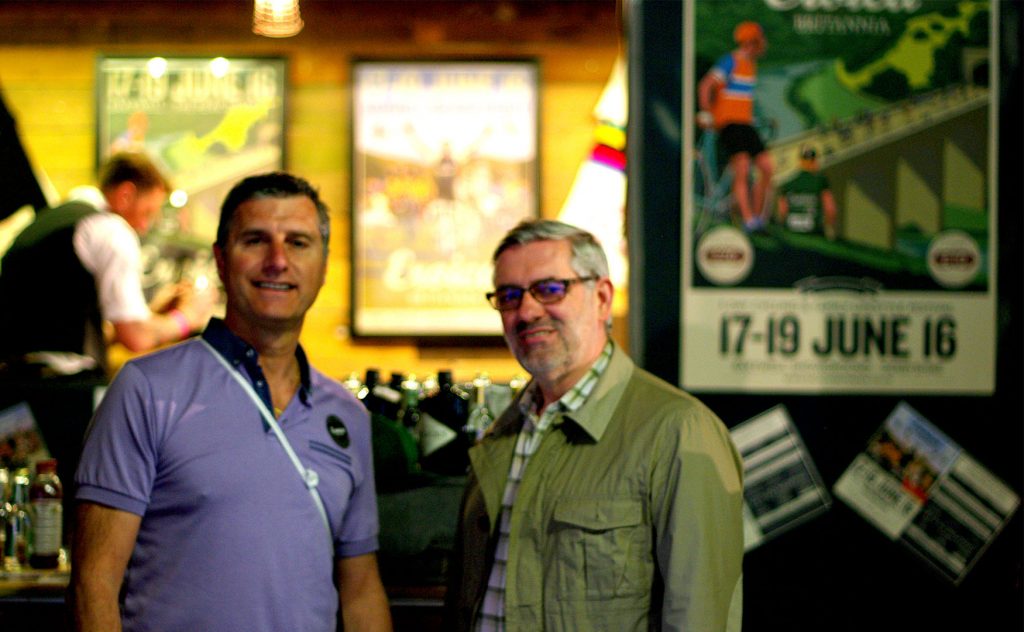
Had a great time visiting the Manchester edition of Spin, the urban cycling festival, and was delighted to meet up with Marco Mori who brought Eroica to Britain.

Seamus and Marco Mori 2 at Spin in Manchester
Meeting Marco Mori at Spin

Eroica Britannia is a 3 day festival of all things vintage and cycling being held for the 3rd year in Bakewell from 17th to 19th June 2016.

After a successful debut last year I am delighted to have been invited back and will be performing a half hour set of my poetry at noon on Saturday 18th. I will of course also be enjoying the festival and will be doing a bit of bike riding too.
Feeling excited.

More about Spin, including some interesting new products, to follow over the next few days and on my writing blog at www.seamuskellypoetry.co.uk 

Monday, 14 December 2015

Back to Basics - Road Race Sprinting Part 2: Technique

Sprinting Technique - Simple, you just go as fast as you can don't you?

Life is of course never that simple and in sprinting there is much more to technique, and that's before tactics are taken into account (that will be the content of my next "Back to Basics" post).


Go as fast as you can?

Surely how fast you can go varies with how far you want to go? Some people believe that sprinting must be the absolute fastest you can go, your ultimate peak speed.

Does that make sense? At the end of a road race the actual sprint effort might need to cover anything from as short as 150m to as long as 400m depending on the circumstances, wind, gradient, competition etc. If you think that "as fast as you can go" is the same for 150m as it is for 400m then you are going too slowly for the shorter distance. It is perfectly possible to "blow" in an effort as short as a sprint just by trying too hard too soon.

If your top speed can be maintained for more than a very few seconds then you ought to be abler to go a bit faster and there are likely to be some technical rather than purely power based issues that you can resolve and by doing so boost that top speed.

During that last few hundred metres of a race, which takes between 10 and 25 seconds to cover, the sprinter will make decisions. The business of exactly what line to take, which riders to follow, how hard to go, when to hit absolute maximum and when to hold a pace just below that are the realm of tactics and not for today's post. But how to actually ride at the highest possible speed for the distance you need to sprint, how to accelerate either as quickly as possible or quickly enough while retaining a little power - those are the aims of this post.

Gearing

Many people see the professionals sprint at Tour de France finishes on massive gears like 53x11 and assume that is what you need to go very fast, fast enough to win sprints. In reality those professionals are often coming off a lead out where they are already travelling at almost 40mph (60kph) before they actually start sprinting. In most other circumstances the sprint in unlikely to start from a speed over 30mph and often more like 25mph (40kph).

It doesn't take much maths to realise that the same gear would not be appropriate. The biggest differences between the Tour de France sprint and the typical amateur sprint finish are:
  • The slower starting speed in the amateur sprint means greater acceleration to reach the top sprinting speed
  • The top speed reached is likely to be lower than the professional sprint
  • The amateur sprint is often (not always) shorter than the professional one
All of those mean that getting that really big gear spinning really fast is unlikely to happen.

This is getting towards the tactics that will be discussed in my next post but the important thing here is that to sprint very fast doesn't mean being in that massive gear unless you've had a really fast lead out to the sprint.

To emphasise that point most riders don't realise just how fast it is possible to sprint on a fairly small gear. It is perfectly possible to sprint at 35mph and faster on gears of around 42x15 or 52x18 (that will also get a mention in the soon to follow post covering training techniques).


Balance and power transfer

In order to go as fast as possible the sprinter can't afford to waste energy and there are plenty of ways to waste that energy; for example if you stand up to sprint and the back wheel skips just a little bit you've not only wasted energy but also wasted a little bit of momentum slowing your acceleration or losing a bit of speed and then having to use up even more energy to get it back.

Many equipment reviews will report on how effective or otherwise the rear triangle and geometry of a particular race bike is at tarring power through to the back wheel or the road. The "Back to Basics" point here is that any modern race bike will do better at transferring that power than most riders themselves will manage unless they develop really good technique.

With your weight too far forward on the bike traction can be lost and that skipping wheel will slow the sprint and cost energy. If the weight is spread too far back the ability to use more of the body to get that power to the road is compromised, in addition the ability to control the bike is also affected so speed and energy are likely to be thrown away in all directions.

Other issues with body position affect the aerodynamics of the bike and rider and the ability to deal with issues that might arise during the sprint (taking evasive action, keeping yourself from being pushed off line etc.) - and that's without considering the distance from the saddle to the pedals (I'm assuming that the racer keen to improve his or her finishing sprint will have already sorted that out - perhaps the makings of another Back to Basics topic?).

Rapid and relaxed pedalling

In order to ride a bike really fast it is essential to be able to pedal very quickly, simply going for bigger and bigger gears just won't work as the torque required will be too high to deal with wind resistance as speed. The power you transfer to the pedals is the combination of the torque exerted and the speed of the legs - revolutions per minute (rpm). Just as a car will strain if you try to accelerate in too high a gear so will a cyclist. To accelerate you need a gear which you can quickly accelerate to high rpm and then for the remainder of the sprint you need to maintain that high rpm (some people will change gear once up to speed but the momentary loss of power whilst changing is likely to remove any perceived advantage).

High rpm on the context of sprinting means being able to accelerate from around 100rpm to around 130rpm whilst still standing and to pedal at a limit of at least 150rpm - many sprinters can pedal faster than 180rpm - that's more than three downward pedal strokes for each leg in the space of a second. Fortunately the technique can be learned and developed further through effective training. It isn't really all that fast - consider that Chris Froome can pedal up very significant slopes at 120rpm.

We all know people who believe they can never pedal faster than about 100rpm; sadly those people will not sprint quickly until they let go of that belief and learn to spin much, much faster. physiologically there really is no reason why any able-bodies cyclist cannot learn to pedal well in excess of 100rpm.

Technically fast pedalling requires the cyclist to be relaxed, to have a good position on the bike and a certain degree of concentration. Any movement other than spinning the legs will be exaggerated as the legs spin faster and those movements are often the real cause of the limit a rider feels when pedalling fast.


Here's a little bit of the science:

In order to ride twice as fast at a constant speed in still conditions on a flat road the amount of power needed to move through the air will be four times as much. Other energy use doesn't increase exponentially this way but pretty soon as speed goes up the only really significant need for power is to overcome that air resistance. If a rider needs say 210Watts to ride at 20mph at least 200 of those will be to push through the air. To double the speed to 40mph would require four times the power to push through the air plus the 10Watts for the other factors (friction, waste etc.) so the total power needed would be 810Watts. Imaging then that the rider is not riding at a constant speed but is accelerating to that 40mph from around 20mph - the power required for that acceleration will depend on the weight of the rider and how fast they want to increase their speed but it is suddenly easy to see how a fast road sprinter will need a peak power of over 1500Watts - Mark Cavendish is reputed to generate around 1800Watts maximum and most sprinters are significantly bigger and need to generate over 2000Watts to have any chance of matching him.

Those figures are just there for demonstration purposes - this is Back to Basics and unless you've got really close to your potential in all other regards you really don't need to know your own numbers.

Power meters, blood and oxygen values and all the little "marginal gains" are the realm of the likes of Team Sky who have not only the equipment to capture the numbers but also the specialists with knowledge to undersatnd and use it. For most riders the application of the techniques here and the training and tactics in the following pages can make "substantial gains" without the investment of anything other than thought and training.

The jump

The jump is the moments where a rider accelerates to sprinting speed and all that balance and control is most important here as this is often the point where any possibility of success or failure is created.

In most cases the rider will accelerate by standing on the pedals, weight fairly centred on the bottom bracket and as each leg pushes at high torque the body and particularly the arm on that side will create a strong platform against which the leverage of the leg can be exerted.

Hands and arms - At this point the hand on the side doing the pushing must grip the bars strongly and the arm pull against the leg - it doesn't need white knuckle grip but a good solid grip that won't let go.  If the arm pulls strongly enough then the bike will rock to the left as the right leg pushes and then as the left leg pushes it will rock to the right. Very often novices and younger riders will exaggerate the rocking movement believing that it will make them faster - it won't; the rocking should only be generated as a result of the amount of power being put into each pedal and the reactive pull on the same side of the handlebars, anything else is wasteful.

If you've ever seen a rider accelerate with a slightly hollow back pushing hips rather than thighs downwards then you've seen a rider throwing away energy and any chance of winning the sprint.

Sometimes the rider will accelerate hard enough to try to gain a gap and to hit a high speed so quickly that it will be hard for anyone else to catch them or come past, other times the rider will make the acceleration to match that of others, to follow the first rider to jump or even just to get things started, encourage others to go and then follow them until close to the line (tactics again - its quite hard to fully separate the techniques and the tactics). Exactly how hard the initial acceleration or jump is will depend on the tactical needs at that moment.

Straight Lines

Another little bit of science (or geometry): the shortest distance between any two points is a straight line.

Watching a finishing sprint with riders veering across the road and weaving left to right might look spectacular, those who remember Adbu in the Tour de France know what I mean, but the fastest way to get to the finish line will always be the shortest distance and that is a straight line. This verges onto tactics but whenever possible the sprint should be as straight as possible to avoid travelling further than absolutely necessary.

In terms of technique sprinting straight is not quite as easy as it sounds, towards the last few metres of a sprint the rider may have reacher their absolute limit and even steering the bike can be difficult. Abdu (Djamolodin Abdoujaparov) famously pointed out that he always naturally drifted to the right, he didn't try to steer that way it was just that once into that final sprint it would happen and he felt he had little control over it.


Sprinting in a straight line means that as well as concentrating on all the technical stuff above, concentrating on tactics and pushing to a level most athletes rarely if ever reach the rider must also concentrate on holding that line. It is worth it because it is the closest and therefore fastest way to the finish.

Technically being very well balanced and being relaxed even under extreme pressure make holding a straight line much easier. When watching other riders the sprinter still needs to know where they are aiming and a bit like cornering having a point to aim at, on or just beyond the finish line, will generally result in straighter sprints. After that it really does boil down to doing lots and lots of sprints, racing and in practice and (verging on to the training post to follow) being able to pull together all the techniques whilst right at the edge of ability is a skill best developed through specialist interval training.

A second kick

As a young racer wanting to know how to move into the top 6 rather than to 10 in road races I realised that I needed to sprint faster and I read anything I could get my hands on (there wasn't really very much back then). The one that had the biggest impact was an interview with Sean Kelly where he described how he had developed a second kick that could make all the difference in a tight finish.
I don't talk much about this at the time but I went out on my own and I worked on that technique during that winter and into the spring and won my first ever big bunch sprint in my first race of the spring (unfortunately it was a sprint for second place, but well inside that top 6).

A final lunge
Monday, 20 July 2015

Back to Basics - Road Race Sprinting Part 1: Introduction and Psychology

We've seen that mad rush to the finish line, the elbow-to-elbow charge at the head of a seething bunch and the last desperate kick on the pedals and literally throwing the bike through the finish line. We may have seen the irrational nudges, shoulder charge or head-butt the frustrated banging on handlebars. We may have heard the noise, felt the rush of wind at the roadside and seen the gasping riders after they've crossed the line. Only a relatively few have been there. This is the realm of the sprinter.
From an interview with Brian Viner in July 2009 this comment by Chris Boardman sums up the psychology of sprinters, he was talking about Mark Cavendish;

"And he doesn't see the world in the same way as everyone else. In a sprint, with bodies everywhere all going at 70mph, I'd see the bodies, but he sees the gaps between the bodies. That's the difference"

I think he meant 70kph but it's still pretty fast; drive down the road at 40mph in your car, these people would be passing you. Now imagine that in a tightly packed bunch just inches apart.

Generally during a sprint, and in the last few minutes before it, the sprinter's body is full of adrenalin. He or she is in the full fight mode. In this situation the brain collects and processes information as fast as it can to such an extent that sprinters often remember every detail as if it were slow motion. The road surface, the movements of the other riders, the moments to make a move, when to make a final kick; all of those things happen so quickly yet the sprinter has plenty of time to react. This high speed processing creates a feeling of control and considering the potential for big accidents they are actually quite rare suggesting that the control is impressively real.

The adrenaline really does, as Chris Boardman said, let the sprinter see things differently from the rest of the bunch. The sprinter's brain really does see possibility; the gap will open up, there is enough room, I can do this. In all the high speed and pressure of a handful of intense seconds the sprinter is still making considered decisions, just faster than any other considered decision you'll ever make. Can I get through, what if so and so goes early, do I follow, do I go 95%, left or right the decisions all taken faster than you can read the words. That's what adrenaline can do. Adrenaline can also make a person hide, shake and run away, turn them into a quivering wreck, but the sprinter uses adrenaline, lives for it and harnesses its power, that's the difference.

Of course there is so much more to the psychology of sprinters.

To anyone other than the sprinter the lead up to the sprint, high speed jockeying for position and that last few hundred metres looks dangerous. Spectators and non-sprinting cyclists see high speed, close proximity, the odd elbow being used and riders blocking each other and pushing to get out of a box and all of this at a speed hovering around 40mph (60kph). In fact for very many cyclists it is just too much and they won't get involved. There is very definitely an element of risk and an element of fear.
The sprinter sees things differently. The biggest risk for the sprinter is not ending up in the gutter with a broken bike and broken bones; by far the biggest risk for the sprinter is someone getting to the line ahead of them. You can recover from broken bones, most serious sprinters know this because they've done so (or they've seen their opponents do so), your bike can be mended, but you never recover from the missed opportunity when you were second across the line. That second place stays with you. The fear of not winning is greater than any fear of crashing and it is this fear that stokes the adrenaline level mentioned above.

Nobody likes to finish second but in a sprinter's mentality it would be better to win the sprint for second place when a lone rider has already won the race than to be beaten to the line in a bunch. It is all about being the absolute fastest in the final rush for the line. There is no greater thrill in sport. The sprinter may dream of a lone race win, and occasionally it might happen, but they tend to be realist and understand that their best chances will always come from within a decent sized group. Winning at the head of a charge of 50 or more riders is always the biggest rush.

When the sprinter doesn't win it doesn't matter what he or she says, they feel a very deep sense of failure. That feeling is horrible and leads to a level of self analysis which some will share and others will internalise. The sprint takes about 10 seconds at the end of hours of racing but in those seconds the sprinter has invested everything, a fraction of a second's hesitation, or starting an effort a fraction of a second too early, misjudging the wind, the gradient or the opponent; all of these things can make the sprinter lose. They are all failures and failure is the sprinters biggest fear.

Telling the failed sprinter that they have another chance tomorrow is no real consolation. Challenging the sprinter to do better (no doing better isn't enough to), challenging the sprinter to win tomorrow has a better chance of success.

When you see Mark Cavendish almost in tears because he or she got it wrong and doesn't need sympathy, he needs the challenge of another race, another boost of the sprinters number one friend adrenaline followed by the second drug of choice; endorphins - winning gives a shot both and makes the sprinter feel better; until the next time.

Essentially the sprinter is the world's fastest addict!


So how do we get into the realm of the sprinter? My next "Back to basics" blog post will focus on the techniques of the sprinter and then I'll look at the tactics of the sprinter and finally at training....


Thursday, 2 July 2015

Eroica Festival - Part 4 - the last day

Sunday morning and the final day of the festival looms, the biggest challenge for me is the 55 mile Derbyshire ride on my old race bike. I'd lowered the gears a bit but am still a bit apprehensive.

Might the late night singing along with Pat's guitar have been too much? Along with Gav, Elizabeth, Grant, Christine and Maggie I'd had a great time listening to Pat's own songs and then singing along to those we knew but arriving back at the B&B at midnight I started to question my wisdom.

We were up early for breakfast which for Maggie included the addition of a large flat mushroom with grilled haloumi - Frank and Wendy excelled once again. As I prepared my bike Wendy was getting ready for the 30 mile ride after a friend pulled out the previous day and offered her their place. Wendy had never ridden 30 miles before and here she was taking the challenge on a 3 speed vintage bike dressed in land-girl dungarees. Later on we heard that she had completed the ride although she was somewhat tired so very well done indeed.

After breakfast I grabbed the bike and with number pinned to my newly acquired vintage-style wool jersey headed for the start in Bakewell.

Me and bike ready for the off....
From Great Longstone it is mostly downhill so I'd decided to ride the few miles to the start as a gentle warm up and although a little cool the weather was lovely. Just past Hassop Station I came across a gentleman (a term that seems particularly appropriate on this day) who having started earlier had a flat tyre just a mile into his ride. He'd changed the tube but was struggling with a mini-pump so I stopped and my 30 year old frame pump so had him back on the road. Half a mile later a large group climbed the hill out of town as I rolled down and among them I spotted an old friend, Simon Burney, who I'd not managed to find all through the weekend.

Down at the start things were quite busy and along with a mixed group of English and Italian riders of all ages (but mostly at the higher end of the scale) I was waved off with cheering crowds and an atmosphere rarely seen at any bike event. We rolled through town and over the bridge and nobody was in a rush. This was not only going to the the most handsome ride but one of the most civilised also. The stronger riders took the wind and sown cruised over Hassop and onto the Monsall Trail. The newly opened tunnels were both impressive and a little cool.
Along the trail I chatted to a fellow rider who turned out to live in Hebden Bridge just over the border from us. First stop, with toilets, came at Miller's Dale just before the first significant climb of the day and many were filling bottles - that reminded me to start drinking a little.
Soon the mixture of roads and trails brought us to the 20 mile point at Harrington where there was plenty of food and drink. As I'd had such a great breakfast I didn't need to eat so had my card stamped added a little water to my bottle and headed out again.

Out on the trails I met up with Pat Carr, fully recovered from his previous night's singing and already half way round the 100 mile route, we had a nice ride and a chat for a few miles and then took our separate routes.

After one of the prettier paths alongside the road we came back to the road and I met another rider stuck at the roadside, his chain completely jammed between the chainring and frame - the mechanics at Harrington had used a lever to unjam it previously but he had no sort of lever and neither did I. He'd been struggling with it for a while and had pretty much given up. Fortunately although I didn't have a lever I did have a plastic bag and some experience in such matters and after a few minutes had him back on the road.

Eroica was that kind of event, if someone looked like they needed help people would stop and offer it as well as they were able. This was the friendliest large bike event I'd ever seen.

After the steep, sometimes loose, mainly damp and sometimes muddy descent of Sheep's Pastures to Cromford at 37 miles the food and drink on offer were very welcome and set me up for the next leg of the ride.

The last stop couldn't come too soon and Chatsworth House along with the ice cream, food and drink was magnificent and a short ride across the grass onto the road for one final big climb before the drop down to Bakewell. Having ridden almost 60 miles since breakfast the climb was tough, almost too much for me, and at the top I had a brief stop to stretch cramping legs.

The last stretch was down the hill to Bakewell. Along with the descent from Beeley Moor which I had first ridden almost exactly 40 years ago on my first club run this final descent was great fun - and although I was passing riders all the way down I still maintain that I was exercising the caution the organisers had advised! 

So there we have it:

Eroica Britannia - truly the most handsome cycling festival, and the friendliest, with superb routes and of course with Shay the Poet!

Roll on next year!


Wednesday, 1 July 2015

Eroica Festival 2015 - Part 3

Saturday afternoon at Eroica Britannia and the Della Grants have done their stuff (look them up on google - in fact why not google all of the acts mentioned here) and then their kit has to be packed away and for 10 minutes that is all, and the crowd drifts away. Next up on stage will be Charlie Jobson, Bakewell's own singer songwriter. We were introduced and chatted to the MC and Charlie wanted to know what I did so he could do a seamless link. He plugged in his guitar, we took our seats and he performed an excellent set of his own music and a handful of covers. He has a lovely voice and was an accomplished guitarist, a pleasure to watch and listen to:

Bakewell's own Charlie Dobson
With a few minutes to go of Charlie's set I spoke to Vicky from the promoters, checked my iPad for the millionth time and then went off to find a quiet corner to compose myself. Performing in front of fellow poets I am used to but this, performing in front of friends who've never seen or heard my poetry plus an audience who probably came for the music, this was a bit nerve wracking. The quiet corner didn't work so I found some friends to chat to instead and suddenly Charlie was on his last song and I was waiting at the side of the stage. As he finished Charlie gave me an excellent introduction and saved the MC a job.

Step onto the stage, adjust the microphone stand, put a bottle of water on the floor and off we go:

My carefully scripted introduction was no longer required I knew what I wanted to say, spoke directly to the audience, told them about being a cyclist and a poet and led into my first poem. 

On stage and taking the audience for a Big Dipper ride....

Apart from a slightly droopy mic stand all was going well. When they were supposed to laugh the whole audience laughed, when they were supposed to be sombre they were, when they heard my saddest poems (The Curse and Dead Eyes) they were quiet and a few tears were wiped away. I picked them up again with more lighthearted poems and finished with a love poem for my wonderful and lovely wife. For the full set list and to read some of the poems head over to my other blog - www.seams

Elizabeth and Grant enjoying the show

Christine and Pat enjoying the show with Gavin's beer bottle just making the shot
A thirty minute Big Dipper of emotions, for the audience or for myself, and the final applause rang in my ears as I stepped off stage to make way for the next bans, Root and Branch. I sat in the audience with friends, Maggie and my brother Brendan (who having queued for over an hour to get in arrived shortly after my set had finished). Now I could really relax and we enjoyed a string of foot-tapping folk tunes before we headed out into the late afternoon of Bakewell.

Root and Branch rounding off the afternoon's entertainment
A brilliant afternoon, a privilege to perform here, a great audience and it couldn't have been better.

The afternoons entertainment left behind we walked to the town centre in search of something to eat and Pat Carr, feeling inspired, stooped off by the bridge to entertain the passing crowds, busking a mix of his own and other's songs with his excellent singing voice and his travelling Martin guitar.

Maggie and I went to the world's number one Bakewell Pudding shop for tea and I bought a pudding to take back to the bed and breakfast....


For a full set list and to read some of the poems head over to my poetry blog at  - http://shaythinkingtoomuch.blogspot.co.uk

For those not on the blog you'll need to buy my book "Thinking too much", available shortly - email info@seamuskellypoetry.co.uk for more details, or catch a performance.